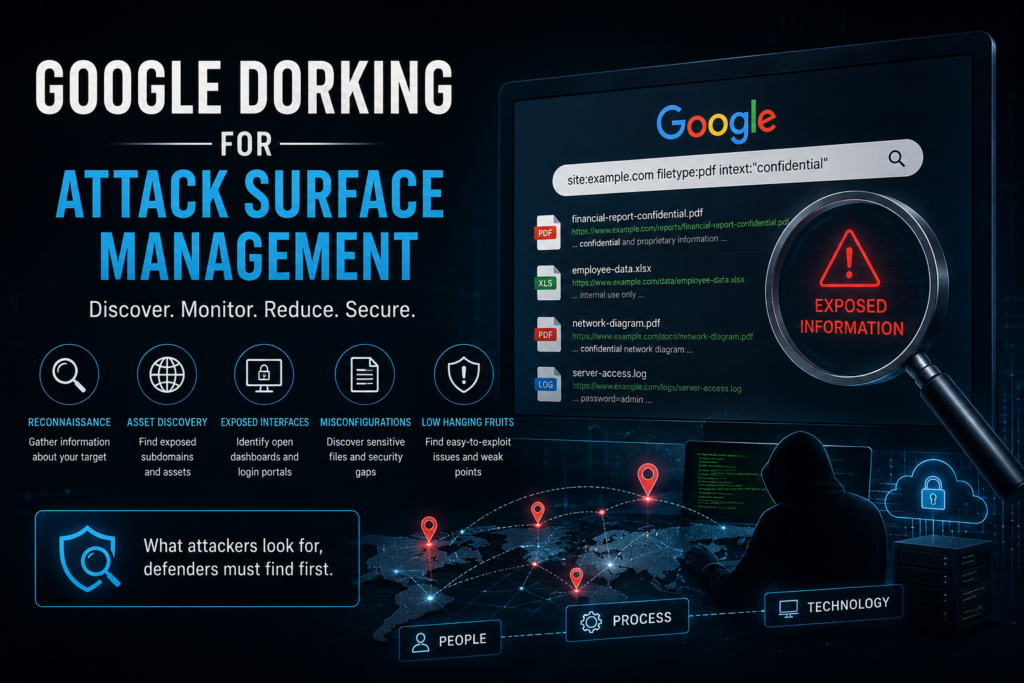
Google Dorking for Attack Surface Management: A Practical Guide for Security Teams
Introduction
Google Dorking, sometimes referred to as Google Hacking, is the practice of using advanced search operators to discover information that has been indexed by search engines. Security professionals use these techniques during reconnaissance and attack surface assessments to identify publicly exposed assets, sensitive information, misconfigurations, and unintended disclosures.
As organizations continue to expand their digital footprint across cloud platforms, web applications, APIs, and third-party services, maintaining visibility into publicly exposed assets becomes increasingly challenging. This is where Attack Surface Management (ASM) plays a critical role.
Attack Surface Management focuses on identifying, monitoring, and reducing the number of potential entry points that attackers could exploit. Google Dorking complements ASM by helping security teams understand what information about their organization is publicly discoverable through search engines.
Common use cases include:
- Reconnaissance and asset discovery
- Identification of exposed subdomains
- Discovery of publicly accessible dashboards
- Detection of security misconfigurations
- Identification of exposed documents and sensitive information
- Discovery of low-hanging security risks
The Role of Google Dorking in Attack Surface Management
Modern organizations often have hundreds or thousands of internet-facing assets. Over time, forgotten applications, legacy systems, cloud resources, and development environments can become exposed without proper oversight.
Search engines continuously index publicly accessible content, making them valuable sources of intelligence for both defenders and attackers.
Security teams can leverage Google Dorking to:
- Discover previously unknown internet-facing assets
- Validate asset inventories
- Identify information leakage
- Monitor exposed documents and reports
- Detect publicly accessible administrative interfaces
- Improve attack surface visibility
When incorporated into an ASM program, Google Dorking helps organizations continuously monitor their external exposure and proactively remediate risks before they are discovered by attackers.
Analysis of Google Dork Categories
Research conducted on publicly shared Google Dorks highlights several categories frequently used by security researchers and bug bounty hunters.
| Category |
Count |
| Advisories and Vulnerabilities |
1 |
| Files Containing Sensitive Information |
243 |
| Login Portals |
68 |
| Online Devices |
11 |
| Vulnerable Files |
1 |
| Vulnerable Servers |
1 |
The analysis indicates that files containing sensitive information represent the most common area of interest. Publicly exposed documents, logs, spreadsheets, and reports frequently contain information that can assist attackers during reconnaissance.
Reference:
https://github.com/kakdesanket/googledorks2023
Google Dorking for Reconnaissance
Reconnaissance is the process of gathering information about a target environment before conducting a security assessment.
For defenders, reconnaissance techniques can be used to understand what information is publicly available about their organization.
Examples of useful search operators include:
Finding Indexed Content
site:example.com
This query helps identify pages indexed by search engines for a specific domain.
Identifying Exposed Directories
intitle:"index of"
Directory listings can unintentionally expose files, backups, and development artifacts.
Discovering Specific File Types
site:example.com filetype:pdf
Useful for locating publicly accessible documents that may contain business-sensitive information.
Searching for Specific Keywords
site:example.com "internal use only"
Helps identify documents or pages that may contain sensitive organizational information.
Asset Discovery and Subdomain Identification
One of the most valuable applications of Google Dorking is identifying assets that may not be included in official inventories.
Organizations frequently discover:
- Legacy applications
- Development environments
- Test systems
- Forgotten subdomains
- Third-party hosted services
Example searches include:
site:*.example.com
site:*.*.example.com
site:example.com filetype:pdf
The goal is not to enumerate systems exhaustively but to identify assets that may require further review and inclusion within the organization’s ASM program.
Discovering Exposed Administrative Interfaces
Administrative portals are common targets for attackers because they often provide elevated access to systems and applications.
Security teams can use search engines to identify administrative interfaces that may be publicly accessible.
Examples include:
intitle:"Dashboard"
intitle:"Admin Portal"
intitle:"Login"
These findings should be reviewed to verify that proper authentication, access controls, and monitoring mechanisms are in place.
Detecting Security Misconfigurations
Misconfigurations remain one of the leading causes of data exposure and security incidents.
Examples include:
- Public directory listings
- Exposed backup files
- Public cloud storage
- Indexed internal documentation
- Development artifacts exposed to the internet
Regular search engine monitoring can help organizations identify these issues before they are exploited.
Identifying Low-Hanging Security Risks
Attackers frequently seek easily exploitable weaknesses that require minimal effort.
Examples of low-hanging risks include:
- Exposed development environments
- Public administrative interfaces
- Test applications
- Publicly accessible documentation containing sensitive information
- Forgotten assets no longer maintained
Addressing these issues often provides significant security improvements with relatively low remediation effort.
Limitations of Automated Google Dorking
While automation can improve efficiency, organizations should be aware of several limitations:
- Search engine rate limiting
- Incomplete indexing
- Delayed search results
- Dynamic content not indexed by search engines
- Restrictions imposed by search providers
Google Dorking should be considered one component of a broader attack surface management strategy rather than a standalone discovery mechanism.
Google Dorking and Continuous Attack Surface Monitoring
Modern ASM platforms combine multiple discovery sources, including:
- Search engines
- Certificate transparency logs
- DNS records
- Cloud asset inventories
- Threat intelligence feeds
- Internet-wide scanning data
By correlating these sources, organizations gain a more comprehensive view of their external attack surface and can continuously monitor for new exposures.
Conclusion
Google Dorking remains a valuable technique for attack surface management and external reconnaissance. It enables organizations to identify publicly exposed assets, detect information leakage, uncover misconfigurations, and improve visibility into their internet-facing footprint.
However, it should be used as part of a comprehensive ASM strategy that includes continuous monitoring, asset discovery, vulnerability management, and proactive remediation.
Organizations that continuously monitor their attack surface are better positioned to identify emerging risks, reduce exposure, and strengthen their overall security posture before attackers can take advantage of newly exposed assets.